Overview
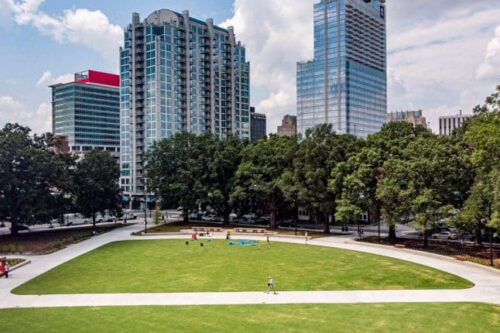
Moore Square Park in downtown Raleigh, North Carolina, demonstrates how thoughtful environmental design can improve public safety, encourage legitimate activity, strengthen community connections, and create measurable public value. Following a major renovation completed in 2019, the park became the focus of a comprehensive post-occupancy evaluation examining how Crime Prevention Through Environmental Design (CPTED) principles influenced both the user experience and long-term community outcomes.
Rather than evaluating the project solely on its appearance or construction quality, the assessment focused on how the redesigned environment performed after completion. Researchers combined visitor surveys, stakeholder interviews, GIS analysis, site observations, mobility data, police incident records, and property research to better understand the park’s safety, usability, and overall community impact.
The redesign emphasized several CPTED strategies, including improved visibility, active programming, territorial reinforcement, and support for legitimate users. These improvements were intended to create a safer, more welcoming public space while encouraging increased use by residents, families, visitors, vendors, nonprofit organizations, and the surrounding community.
The evaluation documented several significant outcomes. Crime within one block of the park decreased by 36%, while drug-related crime was reported to be 6.5 times lower than before the redesign. Visitor surveys found that 88% of respondents reported feeling safe in the park, and 91% reported a stronger sense of community belonging. The park now attracts an estimated 738,051 annual visitors through approximately 500 events and programs each year, strengthening natural surveillance through increased legitimate activity.
The project also demonstrated measurable environmental and economic benefits. The redesign preserved 28 historic oak trees while maintaining a total of 47 trees capable of capturing nearly 5,800 pounds of carbon annually. Nearby property values increased significantly following the renovation, local businesses reported increased revenue during park events, and the park continues to support approximately 70 local vendors throughout the year.
One of the most notable findings from this evaluation is its modeled return on investment. Using a 20-year analytical model based on documented post-occupancy findings, the evaluation estimated that every $1 invested in the Moore Square Park retrofit generated approximately $2.30 in measurable public value through increased property values, local commerce, crime-related public cost savings, recreation, health, and environmental benefits. While this represents a modeled public-value benefit rather than direct taxpayer revenue, it demonstrates how CPTED can contribute to measurable outcomes that extend well beyond crime reduction.
The evaluation also highlights an important lesson for CPTED practitioners: successful projects should continue to be evaluated after construction is complete. Although the redesign produced substantial improvements, researchers identified remaining visibility concerns around portions of the playground and restroom areas, demonstrating that post-occupancy evaluations provide valuable opportunities for continuous improvement and future design refinements.
Moore Square Park illustrates how CPTED extends beyond physical design alone. When environmental design is combined with programming, maintenance, management, and community stewardship, public spaces can become safer, more welcoming, and more economically resilient. The project serves as an excellent example of how data-driven evaluation can demonstrate the long-term value of CPTED investments for communities, practitioners, designers, and decision-makers.